


Diecast Car Scales Explained: 1:18, 1:24, 1:43 and 1:64
By Justin Carlo · · 11 min read
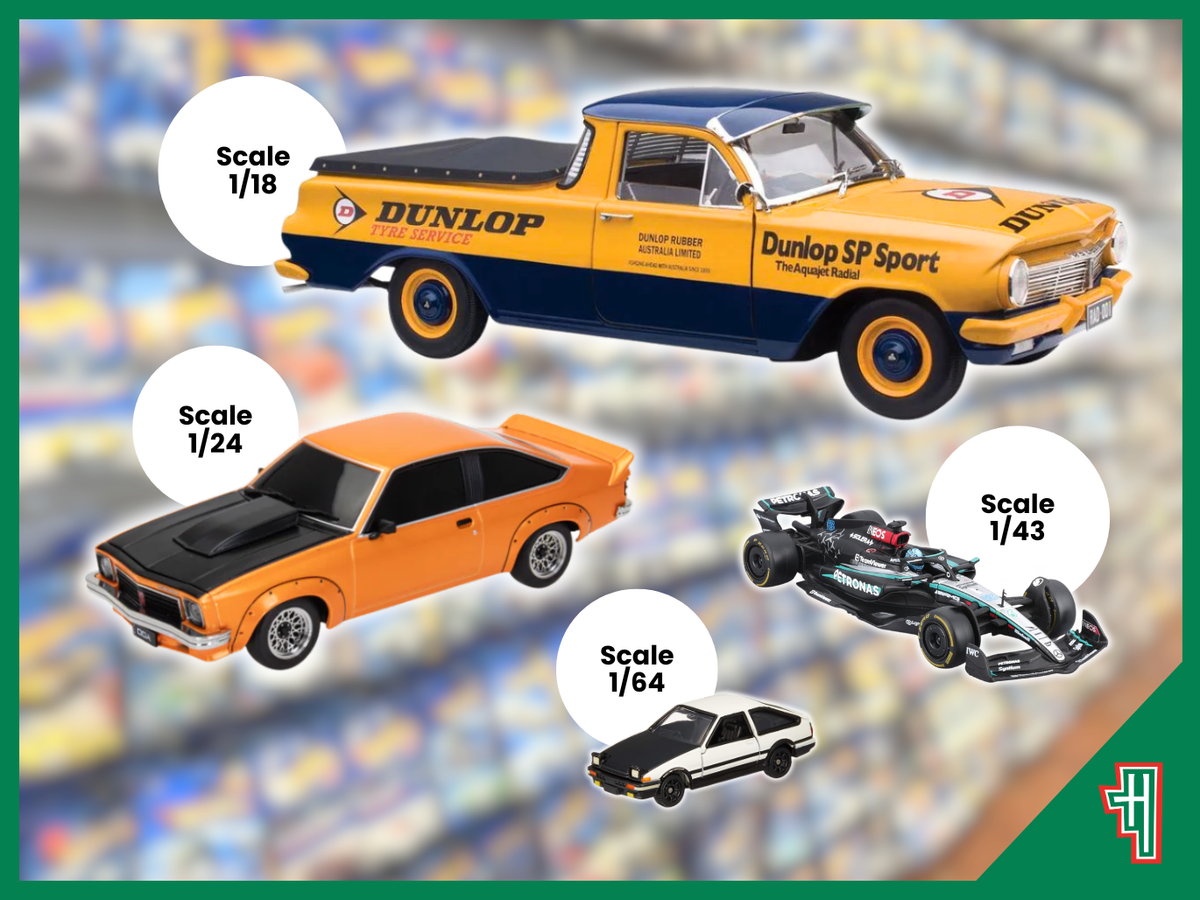
Choosing a diecast car is easier once you understand scale.
The scale tells you how much smaller the model is than the real vehicle. It affects the model’s size, level of detail, price and the amount of display space it needs.
Four of the most common diecast car scales are 1:18, 1:24, 1:43 and 1:64. Each suits a different type of collector.
This guide explains how the scales compare and how to choose the right size for your collection.
You can also visit Hobbyco’s Diecast Cars page to browse models by scale, brand and vehicle type.
TL;DR
-
1:18 scale offers strong detail and display presence but needs the most room.
-
1:24 scale balances size, detail and price.
-
1:43 scale is compact while still offering good exterior detail.
-
1:64 scale is small, affordable and easy to collect in larger numbers.
-
A smaller scale number means a larger model.
-
The final size depends on the dimensions of the real vehicle.
-
Detail and moving features vary between brands and products.
-
Check the product dimensions before ordering if display space is limited.
What Does Diecast Scale Mean?
A scale such as 1:18 shows the relationship between a model and the real vehicle.
At 1:18 scale, every measurement on the model is 18 times smaller than the equivalent measurement on the real car.
At 1:64 scale, every measurement is 64 times smaller.
This means a 1:18 model is much larger than a 1:64 model. The smaller number after the colon produces the larger model.
How to calculate a model’s approximate size
Divide the real vehicle’s dimensions by the scale number.
For example, a real car that is 4.5 metres long would measure approximately:
-
1:18 scale: 25 centimetres
-
1:24 scale: 18.75 centimetres
-
1:43 scale: 10.5 centimetres
-
1:64 scale: 7 centimetres
These figures are only a guide. A compact hatchback will produce a shorter model than a large sedan, even when both are made to the same scale.
Diecast Car Scale Comparison

|
Scale |
Approximate length for a 4.5 m car |
Display space |
Typical detail |
Best suited to |
|
1:18 |
25 cm |
High |
Often very detailed |
Feature displays and close inspection |
|
1:24 |
18.75 cm |
Moderate |
Good balance of size and detail |
General collecting and gifts |
|
1:43 |
10.5 cm |
Low to moderate |
Strong exterior detail in a compact size |
Motorsport and marque collections |
|
1:64 |
7 cm |
Low |
Varies from simple to highly detailed |
Large collections and limited spaces |
The level of detail is not determined by scale alone. Manufacturer, price, materials and the intended market also make a difference.
A premium 1:64 model may have sharper decoration than a lower-priced model in a larger scale.
What Is 1:18 Scale?

A 1:18 diecast car is 18 times smaller than the real vehicle.
Most passenger cars in this scale measure around 23 to 30 centimetres long. Larger vehicles may be longer.
Why collectors choose 1:18 scale
The larger size gives manufacturers more room to reproduce interior and mechanical details.
Depending on the product, a 1:18 model may include:
-
Opening doors
-
An opening bonnet
-
An opening boot
-
A detailed engine bay
-
A detailed interior
-
Steerable front wheels
-
Working suspension
-
Fabric or textured interior elements
Not every 1:18 model includes these features. Some collector models use sealed bodies to prioritise accurate exterior shapes and panel lines.
Display requirements
A single 1:18 model creates a strong display piece. A large collection needs substantial shelf or cabinet space.
Allow extra room around the car if its doors, bonnet or boot open. An enclosed display case can also help reduce dust.
Who should choose 1:18 scale?
Consider 1:18 if:
-
You want one or two feature cars.
-
Interior and engine detail matter to you.
-
You have enough display space.
-
You enjoy photographing models.
-
You prefer close inspection over collecting large numbers.
Brands across Hobbyco’s diecast range include Bburago, Maisto, Classic Carlectables and DDA Collectibles. Available scales vary between each manufacturer and model.
Explore diecast models at Hobbyco to compare current brands and categories.
What Is 1:24 Scale?

A 1:24 car is 24 times smaller than the real vehicle.
A typical passenger car at this scale measures around 17 to 21 centimetres long.
Why collectors choose 1:24 scale
This scale sits between the display presence of 1:18 and the compact size of 1:43.
It is large enough for clear body details and a visible interior, but it is easier to display than 1:18. Selected models may include opening doors, bonnets or boots.
Display requirements
A standard bookshelf or display cabinet can hold several 1:24 cars without feeling overcrowded.
The scale works well for themed displays, including:
-
Supercars
-
Classic cars
-
Movie vehicles
-
Police and emergency vehicles
-
Motorsport collections
Who should choose 1:24 scale?
Consider 1:24 if:
-
You want visible detail without using too much room.
-
You are buying a diecast car as a gift.
-
You want several cars from the same manufacturer.
-
You prefer a model that is easy to handle.
-
You want a balance between price and display impact.
You can browse brands such as Bburago through Hobbyco’s current diecast range.
What Is 1:43 Scale?

A 1:43 car is 43 times smaller than the real vehicle.
Most passenger cars measure approximately 9 to 12 centimetres long at this scale.
Why collectors choose 1:43 scale
The scale has long been popular for road cars, racing cars, rally vehicles and motorsport subjects. It allows collectors to build a broad display without needing the space required by 1:18 models.
Most 1:43 cars focus on exterior accuracy rather than opening features. Interiors are usually visible, but doors and bonnets are often fixed.
Display requirements
A cabinet that holds only a few 1:18 models may hold a much larger group of 1:43 cars.
Many 1:43 products come with a display base or clear cover, although this depends on the manufacturer.
Who should choose 1:43 scale?
Consider 1:43 if:
-
You want to collect cars from a particular team, manufacturer or period.
-
You enjoy motorsport and racing liveries.
-
Exterior accuracy matters more than opening features.
-
Your display space is limited.
-
You want a consistent group of cars on the shelf.
What Is 1:64 Scale?

A 1:64 car is 64 times smaller than the real vehicle.
A typical passenger car measures around 6 to 8 centimetres long, although dimensions vary.
Why collectors choose 1:64 scale
The compact format makes 1:64 one of the easiest scales to collect.
It is commonly used for road cars, Japanese performance vehicles, American vehicles, racing cars and commercial subjects. Some models are designed mainly for play, while others are produced specifically for collectors.
The level of detail can vary considerably. Collector-focused models may include detailed wheels, printed lights, accurate liveries and carefully shaped bodywork.
Display requirements
Large numbers of 1:64 cars can fit into a relatively small cabinet. The scale also works well with miniature garages, workshops and street scenes.
It is a practical option for collectors living in apartments or sharing display space with other hobbies.
Who should choose 1:64 scale?
Consider 1:64 if:
-
You have limited display space.
-
You want to collect many different vehicles.
-
You enjoy road cars, racing cars or performance vehicles.
-
You want accessible entry points.
-
You plan to create a miniature garage or street scene.
-
You prefer variety over large individual models.
Hobbyco stocks compact diecast models from brands including Tarmac Works, GreenLight and Oz Wheels.
Which Diecast Scale Has the Most Detail?
Larger models often provide more room for detailed interiors, engines and moving parts. This gives 1:18 an advantage when physical detail is the main priority.
Scale does not guarantee quality.
Detail also depends on:
-
The manufacturer
-
The product range
-
The retail price
-
The materials used
-
Whether the body is sealed
-
The intended collector
-
The age recommendation
A premium 1:64 car can have excellent paintwork and printing. A basic 1:18 car may be larger but less refined.
Review the individual product photographs and description instead of choosing by scale alone.
Which Scale Is Best for a Diecast Collection?
There is no single best scale. The right choice depends on what you want to collect and where you will display it.
Choose 1:18 for display impact
This scale suits collectors who want a close look at a favourite vehicle. It works well for a small collection of important cars.
Choose 1:24 for balance
This is a practical middle ground. Models are large enough to appreciate easily but do not require as much room as 1:18.
Choose 1:43 for a focused collection
This scale is useful for collecting motorsport teams, vehicle generations or particular manufacturers. It offers good shelf presence without taking over the room.
Choose 1:64 for variety
This is a strong choice for collectors who want many vehicles, have limited space or enjoy building miniature scenes.
Can You Mix Diecast Scales?
Yes. A collection does not need to use one scale.
You might keep a favourite car in 1:18, build a motorsport collection in 1:43 and collect road cars in 1:64.
Mixed scales usually look better when separated into groups. Placing a 1:18 car directly beside a 1:64 version can make the display feel uneven.
Try arranging models by:
-
Scale
-
Manufacturer
-
Motorsport category
-
Vehicle type
-
Country
-
Era
-
Colour
If you prefer a uniform display, choose one main scale before expanding the collection.
For more advice, read How to Start a Diecast Model Collection.
How to Check Whether a Model Will Fit
Do not rely only on the scale printed in the product title.
First, measure the space where the model will be displayed. Then check the product listing for its length, width and height.
Remember to allow room for:
-
Opening doors
-
An opening bonnet or boot
-
A display base
-
A clear cover
-
Mirrors and antennas
-
Space between neighbouring models
If dimensions are not listed, contact the Hobbyco team before ordering. The size of the real vehicle can also be divided by the scale number to produce a reasonable estimate.
Frequently Asked Questions About Diecast Car Scales
What is the biggest common diecast car scale?
Among the four scales covered here, 1:18 is the largest. Scales such as 1:12 and 1:8 are larger again, but they are less common and require considerably more space.
Is 1:18 bigger than 1:24?
Yes. A 1:18 car is larger than a 1:24 version of the same vehicle. A smaller number after the colon means a larger model.
How big is a 1:18 scale car?
A typical 1:18 passenger car is around 23 to 30 centimetres long. The exact size depends on the real vehicle.
How big is a 1:24 scale car?
Most 1:24 passenger cars are approximately 17 to 21 centimetres long.
How big is a 1:43 scale car?
Most 1:43 passenger cars measure around 9 to 12 centimetres long.
How big is a 1:64 scale car?
A typical 1:64 passenger car measures around 6 to 8 centimetres long.
Which diecast scale is best for beginners?
Both 1:24 and 1:64 are practical starting points. Choose 1:24 if you want a larger display model. Choose 1:64 if you want more variety and lower space requirements.
Which scale is best for children?
Suitability depends on the individual product, not only its scale. Check the manufacturer’s age recommendation and small-parts warnings before purchasing.
Which scale is best for adult collectors?
Any scale can suit an adult collection. Choose according to the vehicles you want, your budget, the level of detail you prefer and your available space.
Are all cars in the same scale exactly the same size?
No. Models reproduce the size differences between real vehicles. A 1:43 limousine will be longer than a 1:43 compact car.
Do larger diecast cars always have opening parts?
No. Some large collector models have sealed bodies. Check the individual product description for opening doors, bonnets, boots or steerable wheels.
What scale are diecast aircraft?
Aircraft use their own common scales, including 1:72, 1:100, 1:200, 1:400 and 1:500. Read our guide to understanding scale in diecast aircraft models for more information.
Find the Right Diecast Scale at Hobbyco
Start by considering your display space and the type of collection you want to build.
Choose 1:18 for detail and presence, 1:24 for balance, 1:43 for compact automotive displays or 1:64 for variety.
Hobbyco stocks diecast cars across popular scales, manufacturers and vehicle types. Compare brands, browse car categories and find a model that suits your collection.
Explore diecast cars at Hobbyco or browse the complete diecast range.
Products, scales and availability may change. Check the individual product page for current specifications before ordering.
You may also like
Back to the Future Day: 6 Ways to Bring the Trilogy Home
TL;DR: Celebrate Back to the Future Day with DeLorean model kits, LEGO sets, Scalextric cars, puzzles, games and premium collectables. Whether you are a first-time builder or a serious movie collector, explore Hobbyco’s Back to the Future range to find something from...
How to Clean Diecast Cars Without Damaging Paint or Decals
Learning how to clean diecast cars starts with restraint. A factory-finished model combines painted metal, plastic glazing, printed decoration, decals, rubber-like tyres and small fitted parts. A cleaner or technique that is safe for one component may mark another. This guide uses...
Best Diecast Gifts for Dad: Classic Cars, Motorsport and Collectables
Finding the right Father’s Day gift becomes much easier when Dad already has a favourite car, racing team, aircraft or piece of motoring history. Diecast models turn those interests into detailed, display-ready collectables. They arrive factory finished, require no paint or assembly...
Comments